
TO KNOW, TO GROW
College faculty and students collaborate with community partners on a better future


Our collective impact
The Mary Frances Early College of Education is proud to be the home of passionate individuals who are committed to improving the community and world, whether they are enhancing instruction in the classroom, empowering leaders in education, or helping patients with a range of disabilities or disorders. Below is a breakdown of our new graduates for FY21.


Bernadette Heckman counsels a student in her office.
Bernadette Heckman counsels a student in her office.
RESEARCH SPOTLIGHT
Filling a gap in healthcare
$1.9 million grant to grow Georgia’s behavioral health workforce
For many Georgia residents, finding mental healthcare can be difficult—especially in rural areas of the state.
In fact, almost every county in Georgia is facing a significant shortage of mental health professionals with only eight psychiatrists for every 100,000 residents, according to the American Academy of Child and Adolescent Psychiatry.
To expand the geographic reach of Georgia’s behavioral health workforce, researchers at the University of Georgia will train students to deliver mental and integrated behavioral health services, both in-person and remotely, in high-need areas of the state.
“This grant will use innovative technologies to expand training experiences and support interdisciplinary treatments,” says principal investigator Bernadette Heckman, a professor in the Department of Counseling and Human Development Services. “Students will be trained in and have the opportunity to conduct group teletherapy, a treatment modality likely to become increasingly common in the future.”

RESEARCH AT A GLANCE
FY21
Teletherapy training
Heckman’s $1.9 million grant from the Human Resources and Services Administration will provide graduate students with innovative training opportunities through Georgia’s statewide Tele-ECHO Network, a resource housed in the Georgia Department of Public Health that virtually links interdisciplinary specialist teams to serve rural and underserved communities.
A new Tele-ECHO group will be created specifically for the program to bring student-trainees and health professionals together for key interdisciplinary trainings at several experiential learning sites, including medically underserved rural areas; communities with racially-, linguistically- and economically-diverse clients; crisis centers; AIDS service organizations; K-12 and specialty schools; residential and outpatient substance use treatment settings; and more.
“Because of our already well-established telehealth training program structure, our team can continue to implement all planned training activities regardless of the trajectory of COVID-19,” says Heckman. “Even if future waves of COVID-19 infection occur, we can use our resource-rich platform and the state’s telemedicine network for experiential training purposes.”
Using the telemental health platform, students will develop expertise in remotely assessing, diagnosing, and delivering integrated interventions for youth and adults with psychological and behavioral disorders, as well as conducting group teletherapy.
These skills will ensure graduates of the program receive intensive holistic training as COVID-19 prompts more practitioners and training programs to conduct virtually administered treatments.
FACULTY IMPACT
FY21
Understanding trauma
With the help of faculty in the School of Social Work, Heckman’s project will develop a new training curriculum to cover trauma and trauma-informed care.
According to Jennifer Elkins, co-principal investigator and an associate professor in the School of Social Work, trauma-informed care has become a popular buzzword, but there are gaps in people’s ability to understand and address trauma, particularly the intersection of trauma, substance abuse, physical health, and mental health.
“It’s really important for all organizations and all social service sectors to understand trauma and work from a trauma-informed perspective,” says Elkins. “But my big concern is that we have these hospitals, schools, and other institutions that can understand and recognize it, but now we need the mental health professionals who can treat the trauma that all these other people are recognizing.”
The training grant will expand and maximize experiential learning opportunities in multiple areas, giving graduate students in both counseling psychology and social work supplemental opportunities to interact and learn about interprofessional education and collaboration.
“Most folks are working in interdisciplinary settings, but what happens is we tend to silo off,” says Elkins. “It is essential that we have a common language and common understanding of what we all do and that we’re all working collaboratively together, ensuring everyone has access to services.”
Other researchers on the grant include professors Rosemary Phelps and Jolie Daigle and associate professor Amanda Giordano in the College of Education and Orion Mowbray in the School of Social Work.
—Kathryn Kao
OUTREACH SPOTLIGHT
Supporting new teachers
College works with school district to design, implement induction program
Sometimes the most powerful way to conduct research is to put it in action.
This is exactly how doctoral candidate Erica Gilbertson (Ed.D. ’24) hopes to address a critical need to build a system of high-quality support for new teachers.
With the help of an action research team consisting of three faculty members in the Mary Frances Early College of Education, three Clarke County School District (CCSD) administrators and a policy analyst, Gilbertson designed several interventions to help new teachers navigate a particularly challenging school year due to the pandemic.
Action research is a method used for improving organizations through change, evaluation, and critical reflection. Based on the evidence gathered, positive interventions are then implemented and studied.
In collaboration with the study, Michael Harris—the former executive director for talent management of the CCSD—formed a new teacher orientation (NTO) team to design, implement, and evaluate the district’s induction program.
“The induction action research study has been a powerful and rewarding learning journey,” says Gilbertson, a doctoral candidate in the College of Education’s Department of Lifelong Education, Administration, and Policy. “The NTO team sustained momentum and commitment, despite the pandemic, because we all believe so passionately that new teachers need multiple layers of support to succeed in their transition from pre-service to in-service teaching.”

EXPERIENTIAL LEARNING
FY21
Collaborative learning environments
Throughout spring and summer of 2020, the NTO team met every two weeks to design a virtual NTO for 175 new teachers in the CCSD.
With the help of College of Education faculty members Sonia Janis, Amy Murphy, Sara Kajder, and Kathy Thompson, Gilbertson and Harris used two years of data collected from teacher surveys, focus groups, NTO observations, and more to determine what topics teachers are most interested in learning about professionally, as well as the best support systems for their classrooms.
Across the board, the team found that school-based supportive and collaborative learning communities are a priority for new teachers, as well as content-based professional learning, classroom management, social-emotional learning, digital teaching, and diversity and equity issues.
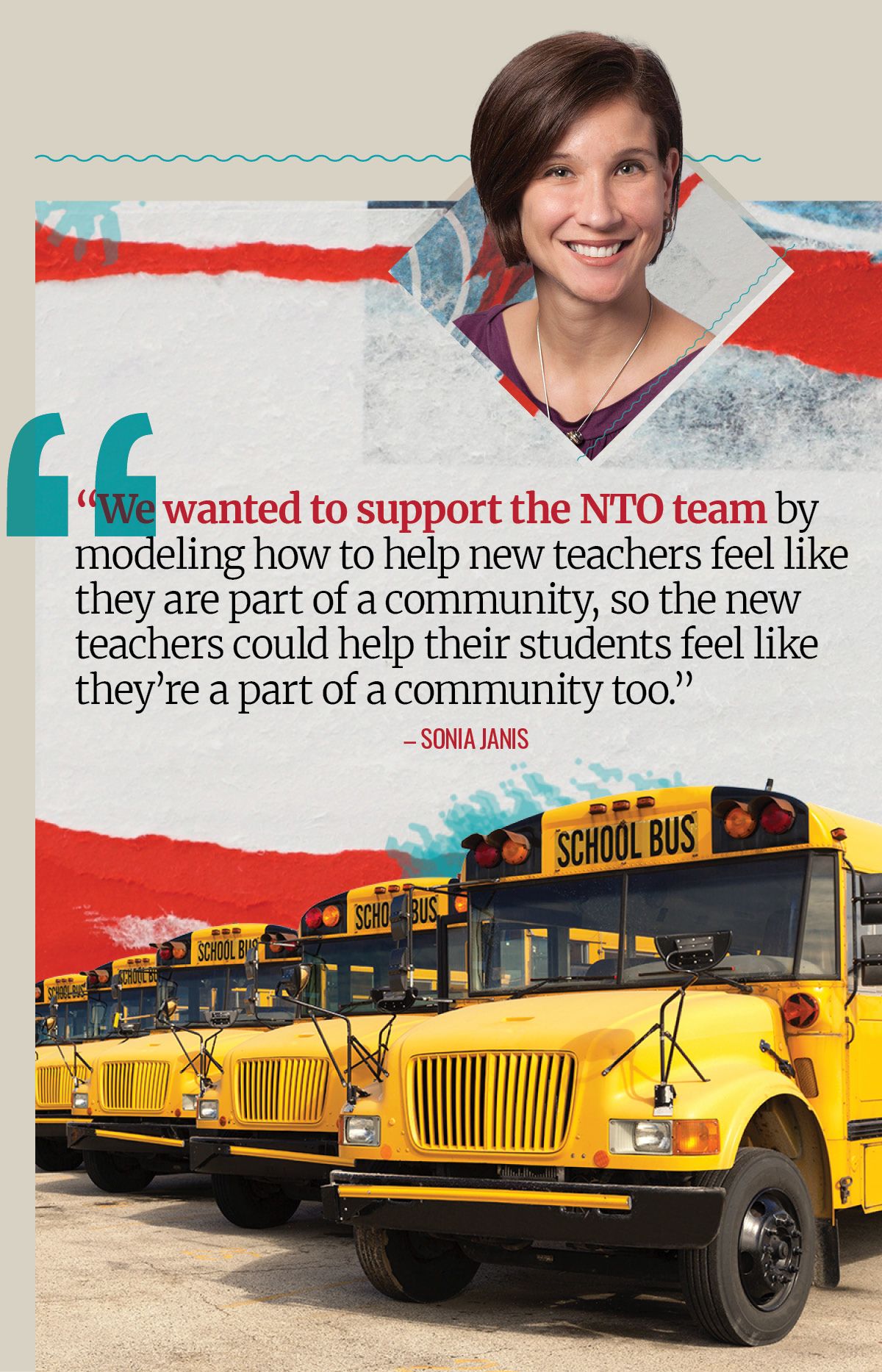
“One of the major things we wanted to accomplish was to study how a partnership between a school district and a university or college of education could work together to address a particular problem,” says Janis, a clinical associate professor in the Department of Mathematics, Science, and Social Studies Education. “We wanted to support the NTO team by modeling how to help new teachers feel like they are part of a community, so the new teachers could help their students feel like they're a part of a community too.”
Prior to NTO, Janis and Kajder developed and implemented a workshop focused on online and group facilitation to help CCSD instructional coaches, lead teachers, and behavioral specialists create and facilitate school-based learning communities for new teachers.
Because data from the research study showed that diversity and equity issues were important topics for new teachers, clinical assistant professor Morgan Faison in the Department of Educational Theory and Practice designed and developed an online equity module for CCSD. She also led an equity workshop for NTO facilitators to prepare them for conversations about equity with new teachers, as well as an equity session for all new teachers during NTO.
Partnerships for change
Overall, teachers reported receiving an overwhelmingly positive learning experience after taking part in the NTO and that the orientation provided them with valuable resources to help them make connections with other teachers.
“A key finding from our study was that new teachers want to collaborate with other teachers in supportive learning communities, so we stayed focused on that in all of the work we did together,” says Gilbertson. “Our goal was to help new teachers thrive, so they stay in the profession, and ultimately, have a positive impact on P-12 student learning.”
In the future, those involved in the study hope to collaborate with CCSD to implement more induction support interventions based on their findings. Ideas include:
- Creating communities of practice for induction teachers
- Designing and implementing dedicated professional learning days at each school for mentor-mentee pairs to observe teachers
- Engaging in professional learning and plan lessons
- Offering content-based professional learning for new teachers
“The action research process cultivated investment in the UGA-CCSD collaboration and resulted in program improvement and learning for all involved,” says Gilbertson. “I am excited about the transformative power of collaborative action research to make systemic change, and I hope to lead more action research studies in P-12 school districts in the future.”
—Kathryn Kao


Action research can help support new teachers in the classroom. Doctoral candidate Erica Gilbertson and her team worked with Clarke County School District administrators to design interventions for new teachers.
Action research can help support new teachers in the classroom. Doctoral candidate Erica Gilbertson and her team worked with Clarke County School District administrators to design interventions for new teachers.


A clinical achievement
Last month, the University of Georgia Speech and Hearing Clinic received the 2021 Best Hearing Aid Center award from the Athens Banner-Herald, a daily newspaper located in Athens, Georgia. The Best of Athens Awards celebrate and recognize the best organizations and businesses in the community.
The clinic, which is housed in the Mary Frances Early College of Education, offers evidence-based, innovative audiology and speech-language pathology services, including free hearing screenings, hearing aid consultations, cochlear implant troubleshooting, stuttering and fluency treatment, and more.
“We are honored to be recognized as the Best Hearing Aid Center in Athens,” says T.J. Ragan, clinical associate professor and director of UGA’s Speech and Hearing Clinic. “We are proud of the innovative, evidence-based services we provide to the community, and we’re grateful to the clients and families who voted for us!”

SERVING THE COMMUNITY
FY21
 Built with Shorthand