
Understanding COVID-19
College researchers examine the pandemic's impact on teachers, students, and citizens





Looking Forward
Study explores impact of COVID-19 on pre-K children’s school readiness skills and recovery rates
By Kathryn Kao
Never before have children across the nation been out of school for as long as they have been now due to COVID-19. As a result, it may take years for students, especially younger children who are still adapting to formal schooling, to recover both academically and social-emotionally in the classroom.
To assess the long-term impact of COVID-19 on young students, researchers at the University of Georgia are investigating the rate at which prekindergarten children return to pre-pandemic levels of school readiness and whether the rate of recovery is similar across all children as they transition through kindergarten and first grade.
The study will also explore school and classroom practices that help explain these rates of recovery to better prepare teachers and school districts for future crises.
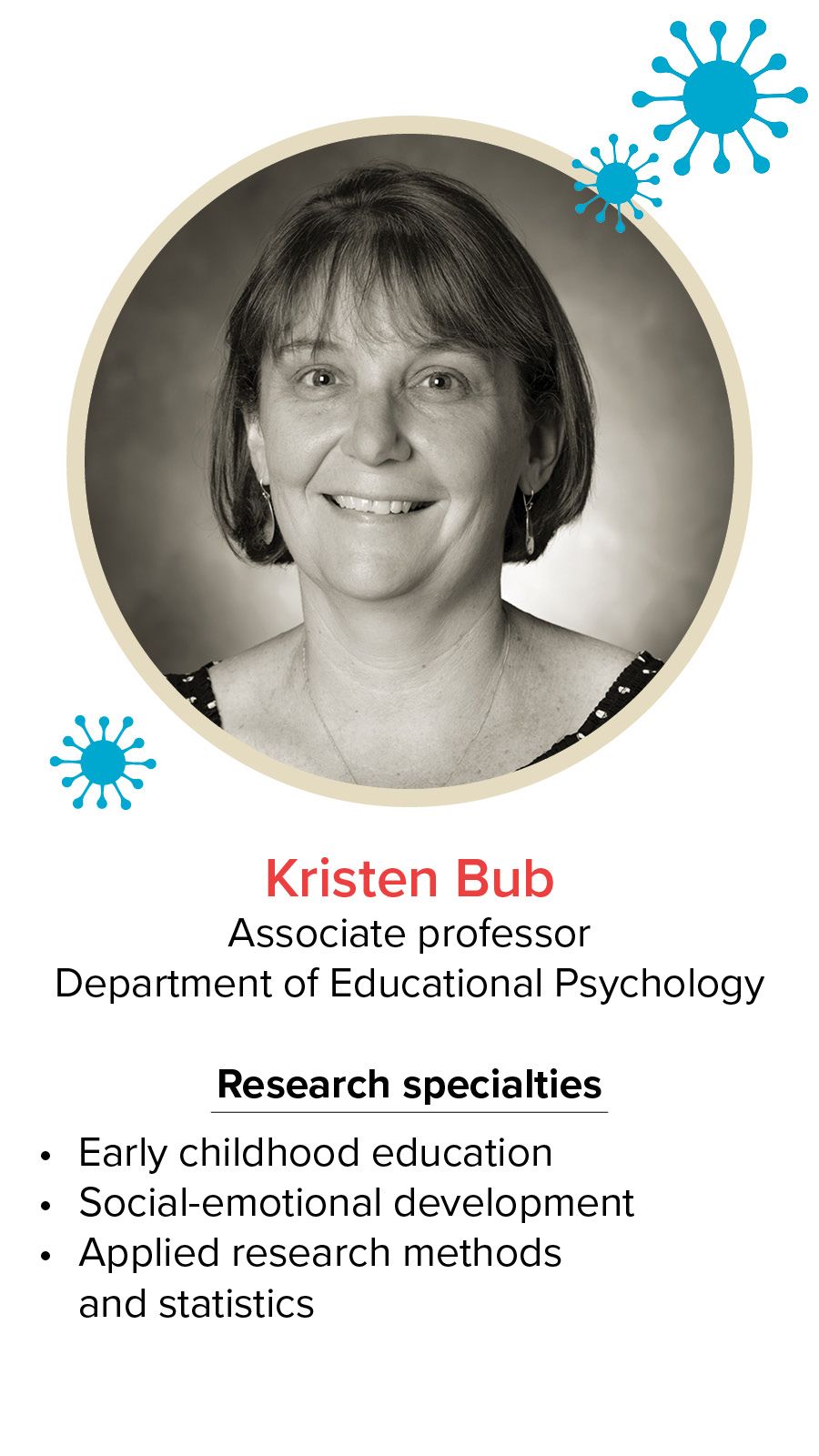
“Pre-K is a particularly vulnerable period for these prolonged absences,” says Kristen Bub, associate professor in the Department of Educational Psychology and principal investigator of the study. “Young children are developing their trust of adults outside of the family. With COVID-19, they go to school one day, and then suddenly they never see their teacher in person again, resulting in a relationship that could be compromised.”
Based on past research of the impact of natural disasters on children’s day-to-day routines, including schooling, Bub expects certain developmental, behavioral, and emotional milestones that children normally develop in pre-K to be severely impacted by COVID-19.
“We also expect—given the long period of time they were out of structured school settings and in-person instruction—that all of the academic, social, and behavioral skills these children are learning will decline over this period,” she says. “We expect these skills to be much lower than would be typical as children make the transition to kindergarten, and certainly lower than you would normally see for just a short summer break.
Additionally, children who already face personal or academic challenges may be at an even greater risk of experiencing more pronounced negative impacts to school readiness due to limited resources in their homes or other care environments.
“Research indicates children from homes with more constrained economic resources have a higher likelihood of lagging behind in academic, social, and/or behavioral skills because they might not have access to the support they need at home. With the unexpected interruption of traditional school, that likelihood is going to be exacerbated,” says Bub. “We think the recovery rate for those children is going to be quite long and that simply being back in a more structured educational environment is not necessarily going to eliminate the loss they experienced over that seven-month period away from the classroom.”
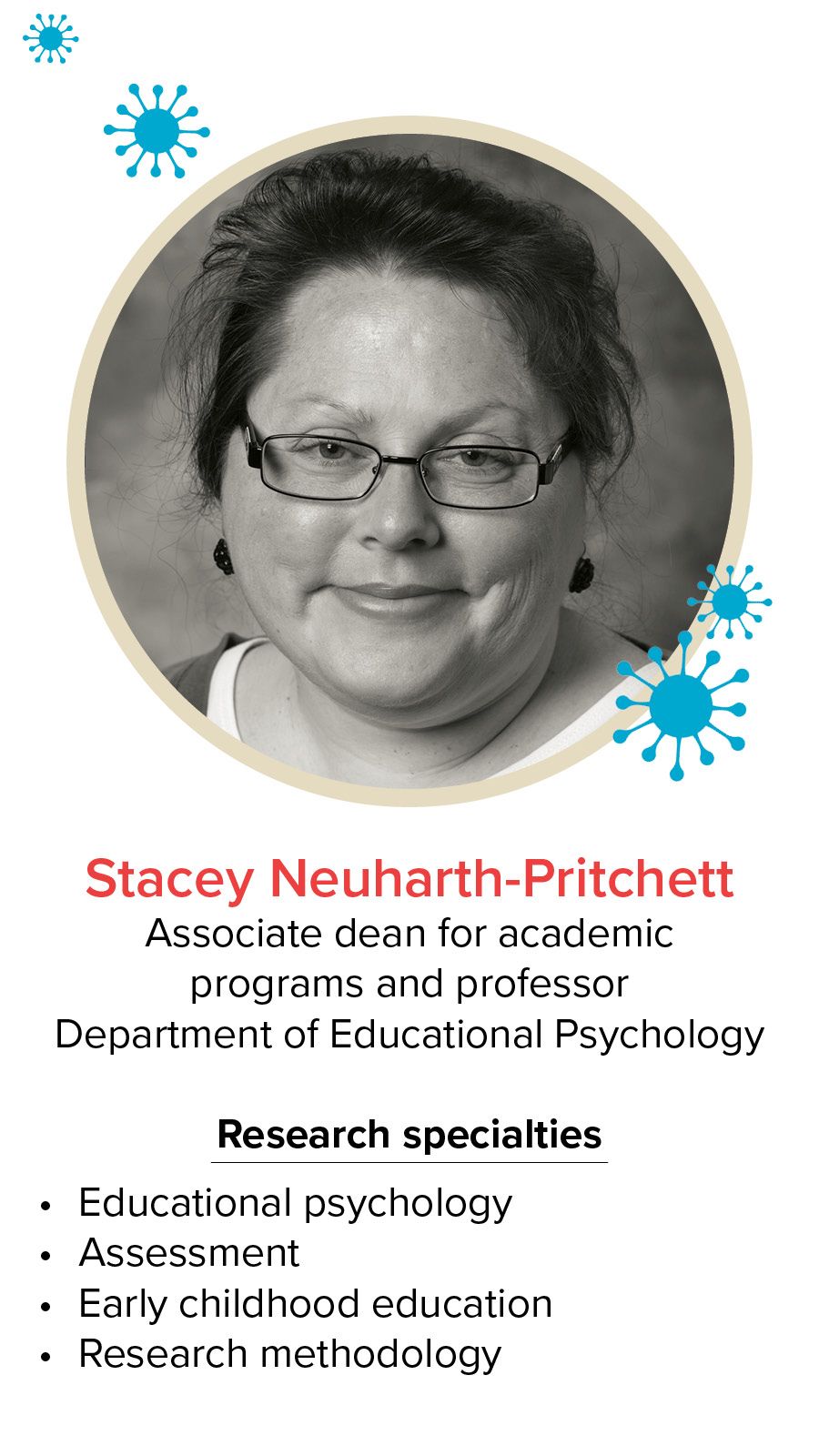
Bub and Stacey Neuharth-Pritchett, associate dean for academic programs in the College of Education and co-principal investigator on the study, are working with all elementary schools in the Clarke County School District to collect data on children’s academic skills (general knowledge of language and mathematics); social skills (ability to communicate, cooperate, and empathize with peers); behavior problems (engagement in bullying, hyperactivity/inattention, and aggression); and relationship skills (teachers’ perceived closeness, engagement, and conflict with students).
COVID-19’s disruption to schooling not only impacted students, but also teachers across the nation who were required to transition their lessons online. Based on initial responses to the study’s online surveys, Bub found that many educators felt unprepared to implement and administer online teaching on such short notice.
As a result, the study will also assess what district-level practices and protocols were provided to teachers for distance learning as schools closed and as they re-open, as well as teachers’ overall stress levels, their feelings of preparedness to transition to distance learning, their perceptions of district or school support, and more.
“We’re hoping the results of this study are informative for the district to convey whether the practices they had in place were helpful to support young children’s academic, social, behavioral, and relational outcomes,” says Bub. “Additionally, we hope our research has multiple levels of implications, not just in providing an understanding of the impacts on child development, but really thinking through how we can better prepare for an event like this in the future.”
The first of five rounds of data have been collected, and the researchers hope to use these initial results, combined with data collected in the fall after students return to school, to determine the impact of extended school shut-downs on students. Data will be gathered across two years, so the study will follow the same group of students from pre-K through first grade.
“We expect we’re going to have some children who aren't going to regain all of their school readiness skills by first grade,” she says. “This may be because some parents are going to be more hesitant to send their children back to school, and we expect we're going to see many more absences in the fall. Even if parents do send their children back to school, they might send them back infrequently, and we might see some children who don't come back until the spring. We don’t know—this is an unprecedented event since we've never had children out of school for this long a period of time.”





Sharing Stories of Resilience
Study to explore how teachers use digital tools to promote learning during the COVID-19 pandemic
By Kathryn Kao
The coronavirus disrupted life around the world with K-12 schools shutting down to mitigate the spread of the virus.
As a result, teachers both nationally and internationally turned to digital tools and the internet to continue teaching students. Because of the unprecedented nature of the pandemic, no standard practices existed for educators to follow during this massive shift in classroom instruction.
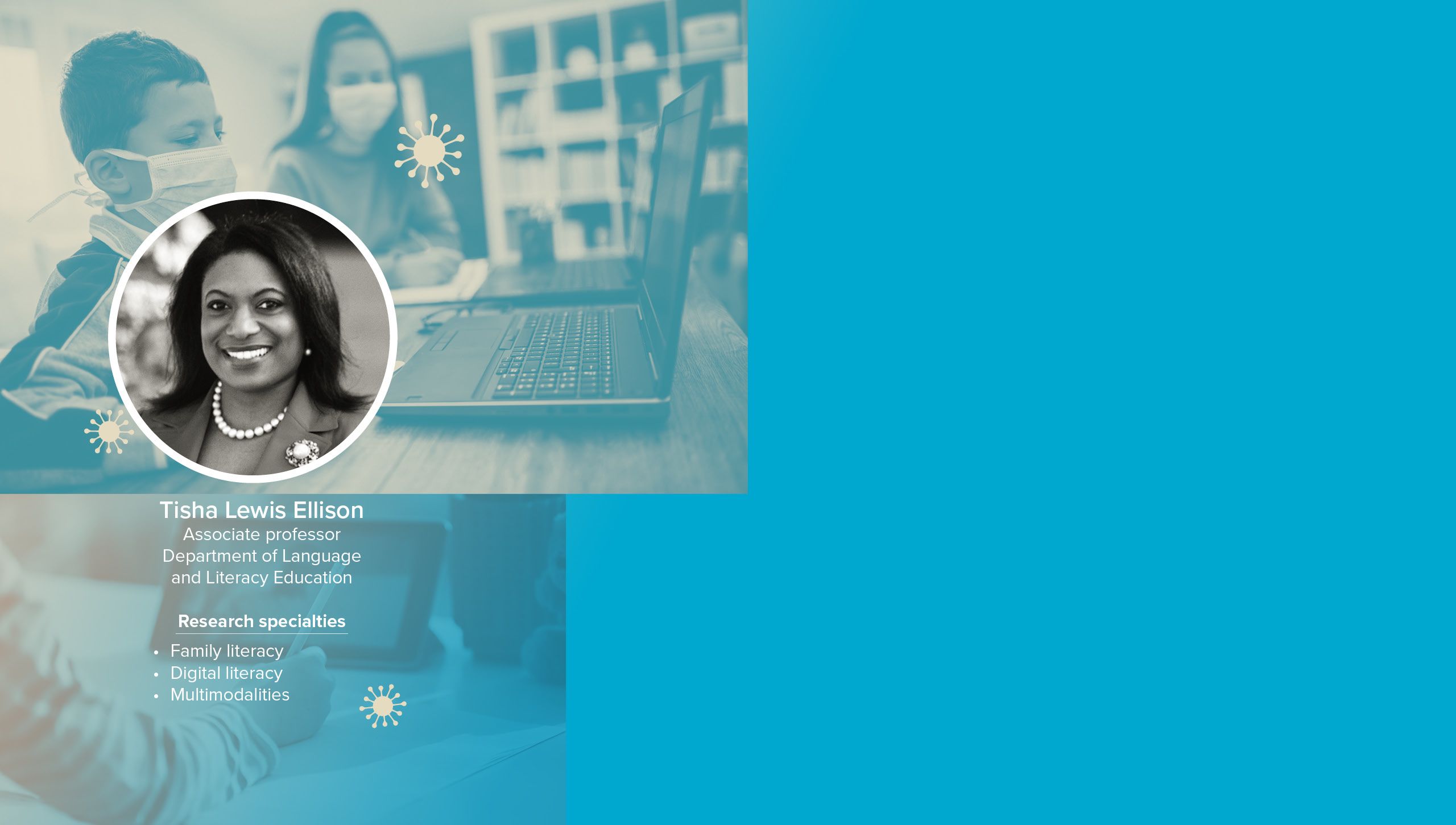
Despite these interruptions, teachers who previously taught face-to-face continued to support students online, resulting in drastically different experiences among educators. To better understand how teachers were supported and prepared to teach with digital tools during the initial outbreak, as well as the beginning of fall semester, associate professor Tisha Lewis Ellison is conducting a mixed methods survey study, titled “Teaching During a Pandemic: How Teachers Used Digital Tools to Promote Learning,” to capture the stories of K-12 teachers around the world.
“Many teachers had to quickly shift from face-to-face to online learning, and a lot of them were very resilient,” says Lewis Ellison, who teaches in the Department of Language and Literacy Education. “Some of them had to teach without any assistance or support. They were scared. We see them as one of many frontline essential workers for our students, and we wanted to humanize their stories from the narratives they chose to write about in our surveys. We want to hear their stories.”
Lewis Ellison and professor Jennifer Esposito at Georgia State University are collaborating on this project and have compiled nearly 300 responses from in-service teachers globally thus far. The survey consists of multiple choice and open-ended questions for teachers to highlight how they were supported by their school districts, as well as their resiliency during these challenging times—both professionally and personally.
Because many educators are also parents, the two are interested in how these teachers responded to the added responsibility of teaching their own children from home using digital tools and devices, such as Google Classroom, Zoom, Microsoft TEAMS, and more.
Lewis Ellison—whose research focuses on the digital literacy practices of African American families and adolescents—and Esposito—whose research focuses on the educational experiences of Black and Brown teachers and students in K-16 environments—are especially interested in how digital tools have impacted and extended students’ learning in the home, as well as how teachers have worked to incorporate anti-racist teaching into their curriculum online.
“We want to highlight teachers who are now having to shift everything digitally, and how that benefits all children, including Black and Brown children,” Lewis Ellison says. “We want to know what they are doing digitally to enhance and cultivate what all students need to learn in the classroom, including the anti-racist learning teachers are incorporating, if any.”
Because many teachers often act as counselors for students in the classroom, the study will also look at how teachers have continued to support their students socially and emotionally. “I have a lot of teacher friends, and I'm hearing firsthand how they are having to operate during this time, personally,” Lewis Ellison adds.
“It’s been a lot of grief, a lot of loss even in their family's lives. So, this pandemic is hitting way beyond just the educational sector. It’s very personal, and we want to pay attention to this viral crisis and teachers’ current mental mindset.”
After analyzing the results from the study, Lewis Ellison and Esposito plan on using the data to create professional development programs and webinars on digital tools to strengthen training and support for K-12 teachers, especially because a second wave of the coronavirus is expected to hit later this year.
The implications for this study also extend beyond the classroom to educational policy. By surveying teachers internationally, the two can assess whether policies and practices implemented by other countries during the pandemic can help inform policy for education in the United States or vice versa.
“Our study has the potential to extend our initial predictions of how teachers are teaching during this pandemic in regards to programming and the policies we can try to implement,” says Lewis Ellison. “We want to humanize these stories and what these teachers are doing. But we’re also not just reading what they’re writing in the surveys; we’re also going to analyze everything and come up with some implications that would be feasible for universities, classrooms, and hopefully, policymakers.”



Newsworthy Models
Research to enhance citizens’ understanding of COVID-19 data, improve data representations used by media outlets
By Kathryn Kao
From the White House and the CDC to CNN and the New York Times, media coverage of COVID-19 continues to surge, with many outlets using mathematical models, including graphs, percentages, and exponential growth, to relay information to the public.
However, existing STEM education research shows that mathematical models commonly used in media representations are difficult to understand for a large portion of the U.S. population. To address these issues, researchers at the University of Georgia and across the nation are conducting a qualitative study to investigate people’s understanding of data representations in COVID-19 media coverage and how these outlets can re-design current representations to enhance the public’s understanding of crucial information.
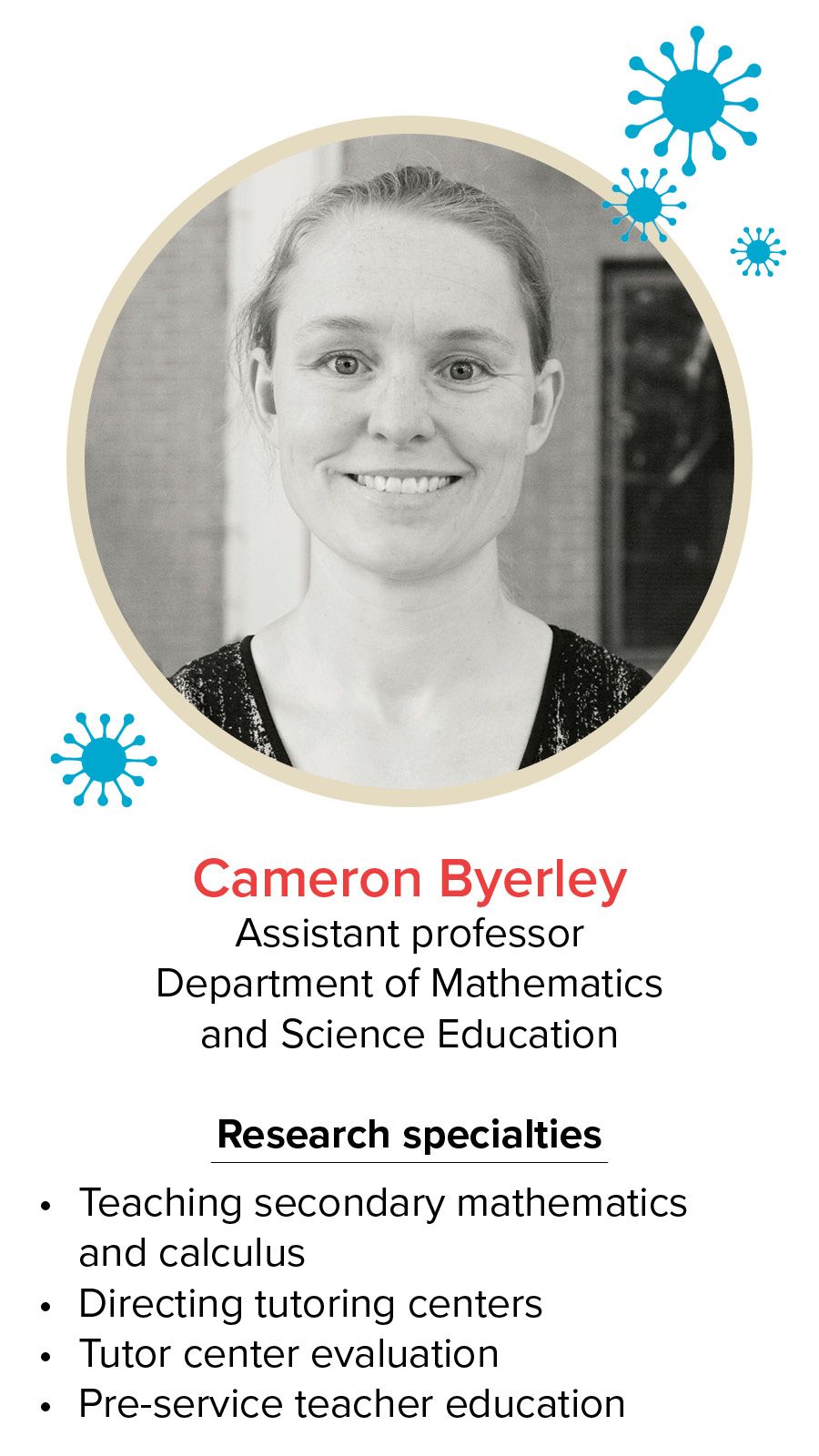
“A lot of the data presented on logarithmic scales by media outlets are not taught in high school Common Core standards,” says Cameron Byerley, assistant professor in the Department of Mathematics and Science Education and principal investigator on the study. “Our goal is to present data in ways that make sense to people who've just gone through the Common Core standards.”
Currently, Byerley and her research team are conducting interviews via Zoom with both U.S. and South Korean participants to gain insight on their understanding of mathematical models as the pandemic unfolds. Additionally, the team is interested in how participants form their social distancing choices based on their perception of the pandemic’s current risk and severity.
Byerley’s pilot findings suggest that people have difficulty using data representations to make decisions about their personal and community health risks, further indicating the need to redesign mathematical models.
“A lot of mathematically true statements that educators commonly teach about slope are actually not very useful if you're ignoring the axes,” she says. “And that's what a lot of people are doing when viewing COVID-19 graphs. If you're only looking at the slope of the graph and the formula for slope, you’re not necessarily looking at the changes in quantities, intervals, or units of measure in the representation—there's all these missing pieces.”
The final round of the study will include modifications to data representation designs, which will be disseminated to relevant research and practice communities, as well as educators and media outlets across the country.
Because few COVID-19 mathematical models are following the recommendations proposed by prior STEM education research, Byerley’s team will form connections with journalists and news producers to help these outlets produce better representations that aid people’s understanding of quantitative data on the coronavirus and future infectious disease pandemics.
“If a graph is moving and the experience of time is built into it, people don't have to track the change of time on the axes—it would just be built into the animation,” she says. “We’re finding that animation is easier for people to digest. Because instead of having to read time and other measures simultaneously, time just moves for you.”
Other recommendations may include adding a disclaimer or showing a video before math models are presented on a website to explain what kind of graph people are viewing (linear vs. logarithmic); highlighting any interval changes on the graph’s axes; or offering built-in animations for certain measurements, such as time and rate of change. By incorporating these new elements and drawing on existing STEM concepts, the team hopes to help individuals make better data-informed decisions related to their health.
“We're going to be able to make stronger conclusions about how people think mathematically,” says Byerley. “When we started the interviews, we discovered we could make graphs better with some tweaks. This is our way to impact the world right now.”
In addition to Byerley, the study’s research team includes Kevin Moore, an associate professor in the Mary Frances Early College of Education; Hyunkyoung Yoon, a faculty associate at Arizona State University; Surani Joshua, an instructional professional at Arizona State University; Min Sook Park, an assistant professor at the University of Wisconsin-Milwaukee; and Laura Valaas, a doctor of medicine student at the University of Wisconsin.



 Built with Shorthand